Conservatorship vs Deputyship vs Lasting Power of Attorney
Author: Octopus Legacy
Last updated: 27 March 2026
Conservatorship vs Deputyship vs Lasting Power of Attorney
If someone loses the ability to make their own decisions, because of dementia, a brain injury, a stroke, or any other condition, someone else needs the legal authority to act on their behalf. But how that works depends on where you are and whether plans were made in advance.
In the US, this is called conservatorship. In England and Wales, the equivalent is deputyship. But there's a better option available to anyone who plans ahead: a Lasting Power of Attorney (LPA).
As Martin Lewis has said, getting an LPA sorted is "arguably more important than a will." A will decides what happens to your assets after you die. An LPA decides what happens to your finances, your health, and your care if you lose mental capacity while you're still alive. Without one, your family may not be able to access your bank accounts, pay your mortgage, or make decisions about your care, even if they live with you.
This guide explains the differences between conservatorship, deputyship, and LPA, and why setting up an LPA now can save your family significant stress, time, and money.
What is Conservatorship?
A conservatorship is a legal arrangement used in some US states. A court decides that someone can't make their own decisions and appoints another person, called a guardian or conservator, to act on their behalf. The guardian can have control over financial affairs, day-to-day decisions, or both, depending on what the court orders.
The rules around what makes someone unable to make their own decisions vary from state to state, each with its own laws and regulations. Conservatorships tend to last for long periods of time, sometimes without a formal end date.
The Britney Spears case
Conservatorship came under global scrutiny through the case of Britney Spears. Her conservatorship was established in 2008, with her father Jamie Spears appointed as conservator of both her personal life and finances. It lasted 13 years before being formally terminated on 12 November 2021, following a highly publicised legal battle and the #FreeBritney movement.
The case highlighted concerns that conservatorships can give too much power to guardians, are difficult to undo, and can be open to abuse. It also sparked wider interest in how different countries handle decision-making for people who lack mental capacity.
Does conservatorship exist in the UK?
No. Conservatorship is a US legal concept. In England and Wales, the equivalent is called deputyship. In Scotland, it's called guardianship (under the Adults with Incapacity (Scotland) Act 2000). In Northern Ireland, it's called controllership (under the Mental Capacity Act (Northern Ireland) 2016).
What is Deputyship?
A deputyship is a legal arrangement put in place when someone already lacks the mental capacity to make decisions for themselves. The Court of Protection appoints a deputy to make decisions on their behalf.
This is the reactive route. It's what happens when no Lasting Power of Attorney was set up in advance.
Types of deputyship
There are two types:
Property and Financial Affairs Deputy: giving the deputy authority to manage bank accounts, pay bills, organise pensions, deal with property, and handle tax affairs.
Personal Welfare Deputy: giving the deputy authority to make decisions about medical treatment, daily care, and where the person lives. Personal welfare deputyships are less common and are only granted when the Court of Protection decides they are necessary.
You can apply for one or both types.
How to apply for deputyship
The person wishing to become a deputy must apply to the Court of Protection. The court will check whether the person genuinely needs a deputy, whether there are any objections to the appointment, and whether the applicant is suitable.
Deputyship application costs in 2026:
| Fee | Amount |
|---|---|
| Court of Protection application fee | £421 |
| Hearing fee (if the court requires one) | £259 |
| Assessment fee for new deputies | £100 |
| Annual supervision fee (general) | £320 per year |
| Annual supervision fee (minimal, estates under £21,000) | £35 per year |
The application typically takes 4 to 6 months to process. In more complex cases, or during periods of backlog at the Court of Protection, it can take up to 12 months.
During this time, the person who lacks capacity may have no one with legal authority to manage their finances or make care decisions on their behalf. This is one of the key reasons why setting up an LPA in advance is so strongly recommended.
Who can be a deputy?
Anyone over 18 can apply. Deputies are usually close relatives or friends. Some people are paid to act as deputies, such as solicitors, accountants, or local authority representatives. The Court of Protection can also appoint a specialist "panel deputy" from approved firms and charities if no one else is available.
The court can appoint two or more deputies for the same person. If there's more than one, you'll need to tell the court whether you're applying as:
- Jointly: all deputies must agree on every decision
- Jointly and severally: deputies can make decisions together or independently
What happens after you become a deputy?
If the application is successful, you'll receive a court order setting out what you can and can't do. You must send an annual report to the Office of the Public Guardian (OPG) each year explaining the decisions you've made. You'll also need to pay the annual supervision fee.
The deputyship continues until the court order is changed, cancelled, or expires based on a date set by the court. It also ends if the person regains capacity or dies.
One-off decisions
If you only need to make a single important decision for someone who lacks capacity (rather than ongoing management), you can apply to the Court of Protection for a one-off order instead of a full deputyship.
What is a Lasting Power of Attorney?
A Lasting Power of Attorney (LPA) is a legal document that lets you (the "donor") appoint one or more people (called "attorneys") to make decisions on your behalf if you lose mental capacity in the future.
This is the proactive route. You set it up while you still have capacity, choosing someone you trust, and giving them the legal authority they'll need if something happens to you. It's faster, cheaper, and far less stressful than deputyship, and it puts you in control of who makes decisions about your life.
Types of LPA
Just like deputyship, there are two types:
Health and Welfare LPA: covers decisions about medical treatment, daily care, where you live, and life-sustaining treatment. This can only be used once you've lost mental capacity.
Property and Financial Affairs LPA: covers decisions about bank accounts, bills, pensions, property, and investments. This can be used while you still have capacity (with your consent) as well as after you've lost it.
You can set up one or both. You can also choose different attorneys for each type.
Who can set up an LPA?
Anyone over 18 who currently has mental capacity can set up an LPA. This is the key difference from deputyship: you must have capacity at the time you create it. Once capacity is lost, the LPA route is closed, and your family would need to apply for deputyship through the courts.
LPA costs in 2026
The registration fee is £92 per LPA (increased from £82 on 17 November 2025). If you set up both a Health and Welfare LPA and a Property and Financial Affairs LPA, the total registration fee is £184.
A reduced fee of £46 is available if your gross annual income is under £12,000 before tax. Full fee exemptions apply if you receive certain means-tested benefits, though from February 2026, Universal Credit no longer automatically qualifies, the OPG now checks total gross annual income.
If you use a professional service, solicitor fees for preparing an LPA typically range from £300 to £800 per LPA. Octopus Legacy's LPA service starts from £699 for a single LPA or £1,299 for both types, with expert guidance throughout the process.
How long does LPA registration take?
Once submitted, registration with the Office of the Public Guardian typically takes 8 to 12 weeks. The LPA can't be used until it's been registered.
Deputyship vs Lasting Power of Attorney: The Key Differences
| Lasting Power of Attorney | Deputyship | |
|---|---|---|
| When you set it up | While you still have mental capacity | After someone has lost mental capacity |
| Who decides | You choose your own attorneys | The Court of Protection appoints a deputy |
| Application fee | £92 per LPA (£184 for both types) | £421 (plus £259 hearing fee if required) |
| Ongoing costs | None | £320 per year (general supervision) |
| Processing time | 8–12 weeks | 4–12 months |
| Court involvement | No - registered with OPG | Yes - requires Court of Protection application |
| Flexibility | You set the terms and choose your attorneys | The court sets the terms and can restrict what the deputy can do |
| Can be set up after capacity is lost? | No | Yes - this is the only option once capacity is lost |
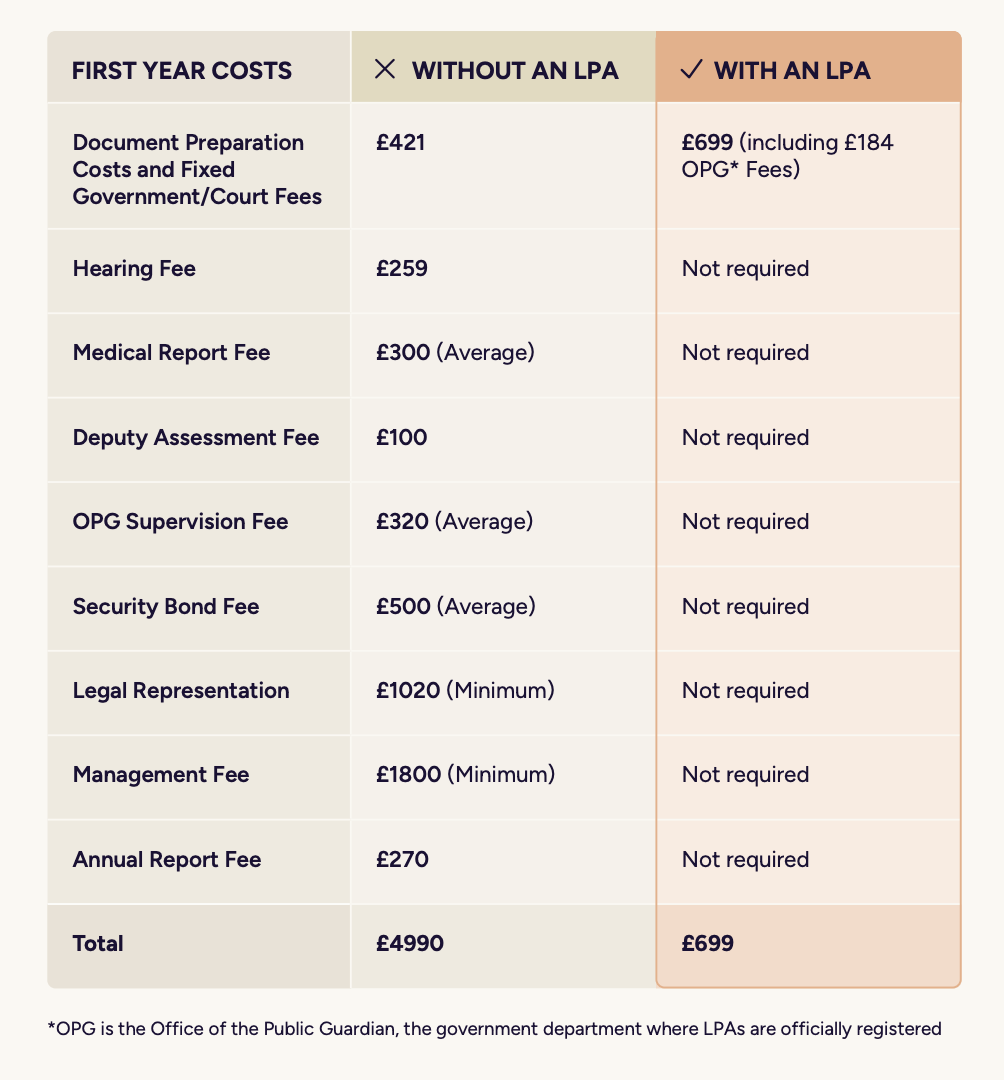
The cost difference is significant. Setting up both types of LPA costs £184 in registration fees. A deputyship application costs £421 upfront, potentially £259 more for a hearing, £100 for the assessment, and then £320 every year in supervision fees. Over five years, a deputyship could cost over £2,000 in fees alone - compared to a one-off £184 for two LPAs.
But the biggest difference isn't the money. It's the time. While a deputyship application works its way through the Court of Protection for months, your family may be unable to access your bank accounts, pay your mortgage, or arrange your care. An LPA avoids all of that.
Scotland and Northern Ireland
Scotland: The equivalent of deputyship is called guardianship, established under the Adults with Incapacity (Scotland) Act 2000. The proactive equivalent (like an LPA) is called a Continuing Power of Attorney (for financial matters) or a Welfare Power of Attorney (for health and care decisions).
Northern Ireland: The equivalent of deputyship is called controllership, established under the Mental Capacity Act (Northern Ireland) 2016. The proactive route is an Enduring Power of Attorney for financial matters. Northern Ireland doesn't currently have a direct equivalent to the Health and Welfare LPA.
If you live in Scotland or Northern Ireland and need help understanding your options, our team can point you in the right direction. Call us on 020 8068 9990.
Why You Should Set Up an LPA Now
One in three people over 65 will develop dementia. But mental capacity can be lost at any age through accidents, strokes, brain injuries, or sudden illness. Once capacity is lost, you can no longer set up an LPA. Your family's only option is the Court of Protection.
Setting up an LPA is one of the simplest and most valuable things you can do for the people you love. It means:
- You choose who makes decisions about your finances and care
- Your family avoids a stressful, expensive, and lengthy court process
- Your wishes are known in advance, so decisions are more likely to reflect what you want
- Your accounts stay accessible, your family can pay your mortgage, bills, and care costs without delay
Set up your Lasting Power of Attorney with Octopus Legacy. Our service guides you through the entire process, from choosing your attorneys to registering with the OPG.
- Start your LPA application
- Or call us on: 020 8068 9990
The cost of not having a LPA
Related Guides
- Set up a Lasting Power of Attorney with Octopus Legacy
- How much does a Lasting Power of Attorney cost?
- Write a will with Octopus Legacy
- Estate administration guide
- What is probate and how does it work?
- Inheritance tax explained
Frequently Asked Questions
What is the difference between conservatorship and deputyship?
Conservatorship is a US legal arrangement where a court appoints someone to make decisions for a person who lacks capacity. Deputyship is the equivalent in England and Wales, where the Court of Protection appoints a deputy. In Scotland it's called guardianship, and in Northern Ireland it's called controllership. All are reactive, they happen after someone has lost mental capacity.
What is the difference between deputyship and Lasting Power of Attorney?
A Lasting Power of Attorney is set up while you still have mental capacity, letting you choose who will make decisions on your behalf. Deputyship is applied for after someone has already lost capacity, through the Court of Protection. An LPA costs £92 per type to register, while deputyship costs £421 to apply plus £320 per year in supervision fees. LPA registration takes 8–12 weeks; deputyship can take 4–12 months.
How much does deputyship cost in the UK?
The Court of Protection application fee is £421. If a hearing is required, there's an additional £259 fee. New deputies pay a £100 assessment fee. Annual supervision fees are £320 per year for general supervision, or £35 for minimal supervision (estates under £21,000). Over five years, deputyship can cost over £2,000 in fees alone.
How much does a Lasting Power of Attorney cost?
The LPA registration fee is £92 per LPA (increased from £82 on 17 November 2025). Setting up both types costs £184 in total. A reduced fee of £46 applies if your income is under £12,000. Professional services typically range from £300 to £800. There are no ongoing annual fees. See our full guide: How much does a Lasting Power of Attorney cost?
Does conservatorship exist in the UK?
No. Conservatorship is a US legal concept, brought to public attention by the Britney Spears case. The UK equivalents are deputyship (England and Wales), guardianship (Scotland), and controllership (Northern Ireland).
How long does it take to get deputyship?
A deputyship application typically takes 4 to 6 months. In complex cases or during backlogs, it can take up to 12 months. During this time, no one may have legal authority to manage the person's finances or care. This is why setting up a Lasting Power of Attorney in advance is strongly recommended.
Can I set up a Lasting Power of Attorney for someone who has lost mental capacity?
No. An LPA can only be set up while the donor still has mental capacity. Once capacity is lost, the LPA route is closed. The only option at that point is to apply for deputyship through the Court of Protection, which is more expensive, takes longer, and doesn't give the family a choice over who is appointed.
Who should set up a Lasting Power of Attorney?
Anyone over 18 with mental capacity can and should consider setting up an LPA. Mental capacity can be lost at any age through accidents, strokes, brain injuries, or sudden illness, not just in old age. As Martin Lewis has said, an LPA is "arguably more important than a will" because it determines what happens to your finances, health, and care while you're still alive. Start your LPA with Octopus Legacy.