Making a will in the UK: Complete Free Guide 2026

Written by Eliza, Legacy Advisor at Octopus Legacy
Last updated: 27 March 2026
Why is making a will in the UK important?
A will is the only legally binding way to say what happens to everything you own after you die. It lets you split your estate between the people you choose, leave specific gifts and messages, appoint guardians for your children or pets, set out funeral wishes, and protect a partner you're not married to. Without one, the law decides, and its decisions might look nothing like yours.
Around 60% of UK adults don't have a will in place. If you're one of them, writing one is simpler, faster and more affordable than most people think. You can write your will with Octopus Legacy online, over the phone, or by video call.
Having a will is particularly important for the following people:
- For parents: If you've got children under the age of 18, writing a will allows you to appoint legal guardians for them. Without this, if anything were to happen to both parents, it's up to the courts to decide who looks after them. That's a decision most parents would want to make themselves.
- For homeowners: If you own property, it's important to properly divide up your estate. A will allows you to keep a record of your assets and to choose exactly how much you want people to inherit. This helps to prevent family disputes that can arise when there's no clear instruction.
- For cohabiting couples: If you live with a partner but aren't married or in a civil partnership, they have no automatic right to inherit anything from you under the rules of intestacy. A will is the only way to protect them.
- For people with digital assets: If you hold cryptocurrency, online accounts, digital businesses or valuable digital content, a will is essential for making sure these assets are passed on properly. Since the Property (Digital Assets etc.) Act 2025, crypto and other digital assets are formally recognised as property under English law, which means they form part of your estate.
- For people with an existing will that hasn't been updated: Many people believe a will is a one-time event. In fact, the government recommends you review your will at least once every five years. If you've been through a significant life change, such as becoming a parent, buying a house, getting divorced, or starting a business, you should update your will.
What happens if I don't have a will?
There are financial and emotional costs to not having a will in place. Financially, it costs a family on average £9,700 in lost assets if someone dies without a will. Without a will you also don't have any control over who inherits your assets and possessions. The rules of intestacy decide for you, and they follow a rigid legal hierarchy that doesn't account for your actual relationships or wishes.
Then there are the emotional costs. It can be stressful for a family if they're having to guess at your wishes after you've died. This is particularly true when it comes to funerals. When someone has funeral wishes in place it can give their family peace of mind, knowing that they're saying goodbye in a way that respects what that person wanted.
Writing a will also lets you make practical decisions that protect your family: appointing executors, setting up trusts, planning for Inheritance Tax, and making sure nothing falls through the cracks.
What information do I need to write my will?
Below we outline what you need to be thinking about as you write your will.
If you need to appoint legal guardians
If you have children under 18, your will allows you to appoint legal guardians who'll take care of them after you've died. If you die without appointing guardians, it's up to the courts to decide. Guardians are, fortunately, not often called upon. But choosing the right people, just in case the worst happens, is one of the most important things a parent can do.
If you have pets, you can also use your will to name someone you'd like to take care of them.
Making an inventory of your estate
When someone dies without a will, money is often lost because assets can't be found. Listing your assets in your will is a good way to let your family know where to look and reduce the burden on your executors.
You don't need account numbers or exact values. A simple list is enough: property, savings accounts, pensions, investments, insurance policies, vehicles, valuables, and any debts.
This list doesn't need to be 100% accurate at the time of your death. If you buy a house and don't update your will, it'll still form part of your estate. But your executors will have to spend time and money tracking it down. That's why updating your will every five years, or after any major life change, is so important.
Including digital assets
This is an area that's become increasingly important. Your digital estate might include:
- Cryptocurrency: Bitcoin, Ethereum, and other crypto holdings are now formally recognised as property under English law following the Property (Digital Assets etc.) Act 2025. This means they form part of your estate and can be inherited. However, if nobody knows your private keys or seed phrases, those assets could be lost forever. Your will should reference your crypto holdings and include instructions on how your executors can access them (without writing private keys directly into the will itself, as wills become public documents after probate).
- Online accounts: Email accounts, social media profiles, cloud storage, streaming subscriptions and domain names. Some platforms have their own legacy or memorialisation settings (like Facebook and Google), but a will gives your executors the legal authority to deal with your digital footprint.
- Digital businesses: If you earn income from a website, app, YouTube channel, online store or digital content, these are assets with real value. Your will should specify who inherits and runs them.
- NFTs and digital collectibles: Like crypto, these are recognised as property and should be accounted for in your estate planning.
The simplest approach is to keep a secure, up-to-date document (separate from your will) that lists your digital accounts and how to access them. Your will can then reference this document and name the person responsible for dealing with your digital estate.
Including business assets
If you own or part-own a business, your will needs to account for this. Business assets can include shares in a limited company, partnership interests, sole trader assets, intellectual property, and equipment.
Without a will, the intestacy rules could force your business into the hands of someone who has no interest in running it, or trigger a forced sale. Key things to consider:
- Shares: Your will should specify who inherits your shares and whether they should be offered to existing shareholders first.
- Partnership agreements: Check whether your partnership agreement includes provisions for what happens on death. Your will should work alongside this, not against it.
- Sole trader businesses: If you're a sole trader, the business is you. Your will should name someone capable of winding it down or continuing it.
- Business Property Relief: From 6 April 2026, 100% Inheritance Tax relief on business property is capped at £2.5 million per individual. Above this, 50% relief applies (an effective 20% tax rate). If your business is worth more than this, specialist tax planning within your will is essential.
Choosing executors
In your will you're required to choose executors. These are the people who take on the task of following the wishes set out in your will, in particular the distribution of your estate.
It's usually best to pick someone organised who is confident dealing with paperwork and finances. You can name more than one executor, and you can also appoint a professional (such as a solicitor or a service like Octopus Legacy) if you'd prefer not to burden a family member.
Funeral wishes
Funeral wishes are an optional addition to a will and a great way to help your family after your death. Knowing that they're saying goodbye in a way that represents your beliefs can be comforting.
Have you thought about what you'd like people to wear? Are there any poems or readings that you like? Would you like a service and wake? Cremation or burial? These wishes aren't legally binding, but they can help to avoid conflict between family members. Maybe there are specific people you'd like invited to the funeral that your family wouldn't otherwise know about.
Do I need a solicitor to write a will?
It's a common belief that you need a solicitor to write a will. For many people, that's not the case. If your circumstances are fairly straightforward, an online will service will give you the same legal result for a fraction of the cost.
At Octopus Legacy, our online will was drafted by our legal team. When you write your will with us, you're completing the will with your information for our legal experts to review. This is simpler and cheaper than organising anything face-to-face. We double-check every will that's written online and get in touch if there are any problems.
There are some circumstances where a solicitor may be the better choice. You might have a complex estate, high-value business assets, foreign property, a blended family situation, or want specific Inheritance Tax planning. We can help with complex wills too, including wills with trusts. And if you're not sure which route is right for you, our team can talk you through it.
What are the different ways to write a will?
There are three main options:
- Using a solicitor
- Making a will online
- Writing a will at home (DIY)
For a will to be valid it needs to meet certain conditions, and given that it's easy to make a mistake, you should be confident with whichever route you choose.
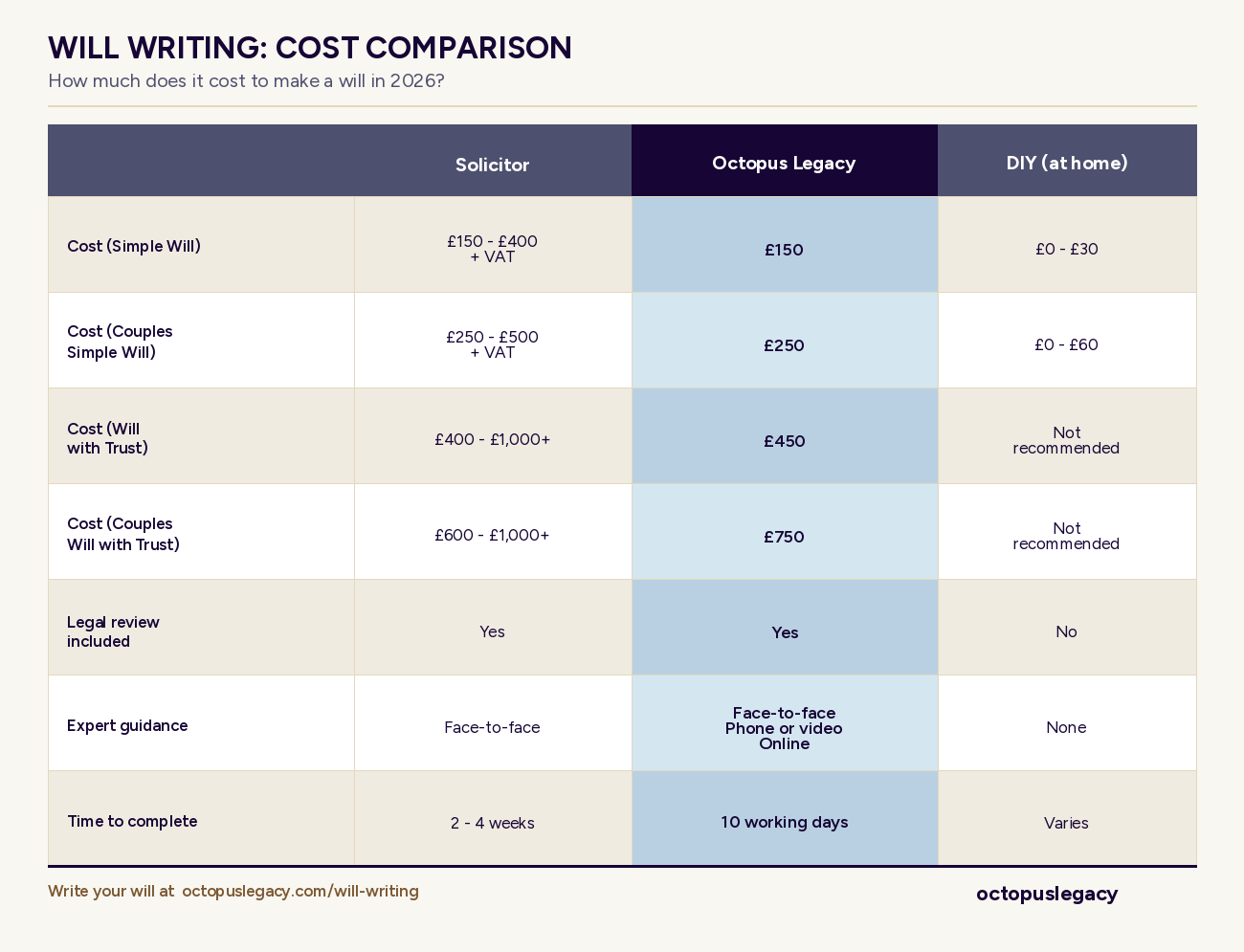
Comparison: Solicitor vs Octopus Legacy vs DIY
1) Using a solicitor to write your will
Solicitors are the most traditional way of writing a will. However, it's also often the most expensive option. For a simple will, solicitors typically charge between £200 and £250. More complex wills can cost £500 or more, particularly if they involve trusts, overseas property or detailed Inheritance Tax planning.
If you require a complex will, which generally means you have a very large or complicated estate, you might need to speak to a solicitor. Along with one of the best online will services, we have a great network of solicitors. If you think you might need a complex will, you can call us on 020 4525 3605 for guidance.
2) Making a will online
This is the easiest and most affordable way to get your will sorted for most people. When you write your will online with Octopus Legacy, you complete a questionnaire about yourself and your family. Once this is done, we draft your will and send it for expert legal review before returning it to you to be signed and legally validated.
You can write your will online, over the phone, or by video call. Our team is always available to help if you want to talk through your options with an expert.
Our pricing:
- Simple will (online, video or phone): £150
- Two simple wills for couples (online or phone): £250
- Will with trust: £450
- Couples will with trust: £750
We take the stress out of making a will. With Octopus Legacy, you can privately prepare your will at your own pace. If your circumstances change, updating your will is straightforward.
3) DIY will-writing
This is the cheapest option but also the riskiest. It typically involves buying a template online or at a shop. We've written about DIY wills before, and our advice is to approach with caution.
Things to consider when making a DIY will:
- You must be over 18
- You must have the mental capacity to make a will
- The will must be signed, dated and witnessed correctly
- It must state that it replaces all previous versions (which should also be destroyed)
- All important information must be clear and not misspelt
- If in doubt, have it checked by a solicitor
A DIY will can work for very simple estates, but any mistake in wording or execution can make it invalid or open to challenge. For most people, the small cost of an online will service is worth the peace of mind.
How can I write a will quickly?
The process of talking through your wishes with a legal professional can be time-consuming and quite daunting. On the other hand, you wouldn't want to rush writing your own will without knowing what you're doing, as it could be contested.
Online wills have solved this problem. You get the convenience of writing your will at home without losing the insight and skills of a legal professional. In just 15 minutes you can write a will and send it off to be checked by an expert.
How much does it cost to make a will?
Our online will costs £150 for a single will and £250 for a couples will. For wills with trusts, pricing starts at £450 (single) and £750 (couples).
How does this compare to other options?
The cost of making a will with a solicitor varies depending on your circumstances. For a simple will similar to our online will, it can cost anywhere from £200 to £250 with a solicitor. More complex wills can cost £500 or more. You may need a complex will if you have a particularly large estate, foreign assets or a complicated family situation.
As mentioned, the Law Society recommends that you review your will every five years, or any time you experience a major life change. Some solicitors charge £50 to £150 for each update (codicil), whereas many online will services include updates at a lower cost or as part of an ongoing subscription.
Frequently Asked Questions
How much does it cost to make a will in the UK in 2026?
A simple will costs between £150 and £250 depending on the method. Online will services like Octopus Legacy charge £150 for a single will or £250 for couples. Solicitors typically charge £200 to £250 for a simple will. More complex wills involving trusts or tax planning can cost £500 or more.
Do I need a solicitor to write a will?
No. Most people with straightforward circumstances can write a legally valid will using an online service. A solicitor may be the better choice if you have a complex estate, high-value business assets, foreign property, or need detailed Inheritance Tax planning. Online will services like Octopus Legacy include legal review by qualified professionals.
How do I include cryptocurrency and digital assets in my will?
Since the Property (Digital Assets etc.) Act 2025, cryptocurrency and digital assets are formally recognised as property under English law and form part of your estate. Your will should reference your digital holdings and name someone responsible for dealing with them. Keep a separate, secure document with access instructions (private keys, seed phrases, passwords). Don't include these in the will itself, as wills become public after probate.
How long does it take to write a will online?
Writing a will online typically takes around 15 minutes. You complete a questionnaire about yourself, your family, your assets and your wishes. The will is then drafted and reviewed by a legal expert before being sent back to you for signing and witnessing. Get started with Octopus Legacy.
How often should I update my will?
The Law Society recommends reviewing your will at least once every five years. You should also update it after any major life change, such as getting married or divorced, having children, buying property, receiving an inheritance, or starting a business.
What happens if I die without a will in the UK?
If you die without a will, your estate is distributed according to the rules of intestacy. These rules follow a strict legal hierarchy starting with your spouse or civil partner, then children, then other relatives. Unmarried partners, stepchildren, and friends have no automatic right to inherit. A 2014 study estimated families lose an average of £9,700 in assets when there's no will. Learn more in our guide to dying without a will.
Can I include my business in my will?
Yes, and you should. Business assets including shares, partnership interests, sole trader assets and intellectual property all form part of your estate. Without a will, intestacy rules could force your business into unwanted hands or trigger a sale. From April 2026, 100% Inheritance Tax relief on business property is capped at £2.5 million per individual, making tax planning within your will even more important for business owners.
Is a DIY will legally valid?
A DIY will can be legally valid if it meets the requirements: you must be over 18, have mental capacity, and the will must be properly signed, dated and witnessed. However, DIY wills carry a higher risk of errors in wording or execution that could make them invalid or open to challenge. For most people, the small cost of a professionally reviewed online will is worth the peace of mind.