What Happens If You Die Without A Will?
Written by Laura Puentes Gantiva, Head of Legal at Octopus Legacy
Last updated: 27 March 2026
What happens if I die without a will?
If you die without a will, the law decides who inherits everything you own. Your wishes don't come into it. In England and Wales, a set of rules called the "rules of intestacy" kick in automatically. These rules follow a strict order of priority, starting with your spouse or civil partner, then children, then parents, and so on down the family tree. If you're unmarried and living with a partner, they inherit nothing under these rules, no matter how long you've been together.
That's worth repeating: cohabiting partners have no automatic right to inherit under intestacy law in any part of the UK.
With the majority of adults in the UK not having a will in place, intestacy is far more common than most people realise. You may have had experience, or at least know someone who has, of the burden this can place on a family. The good news is that it's straightforward to prevent. Writing a will means you decide who gets what, who looks after your children, and how you want to be remembered. You can write your will with Octopus Legacy and get it sorted in a way that actually reflects your life.
This article covers the intestacy rules across England and Wales, Scotland and Northern Ireland, including how they apply to cohabiting couples and blended families, and the key Inheritance Tax thresholds for 2026.
Intestacy flowchart: who inherits if there's no will?
The flowchart below shows how assets are distributed under the intestacy rules in England and Wales. Scotland and Northern Ireland have different rules, which we cover further down.
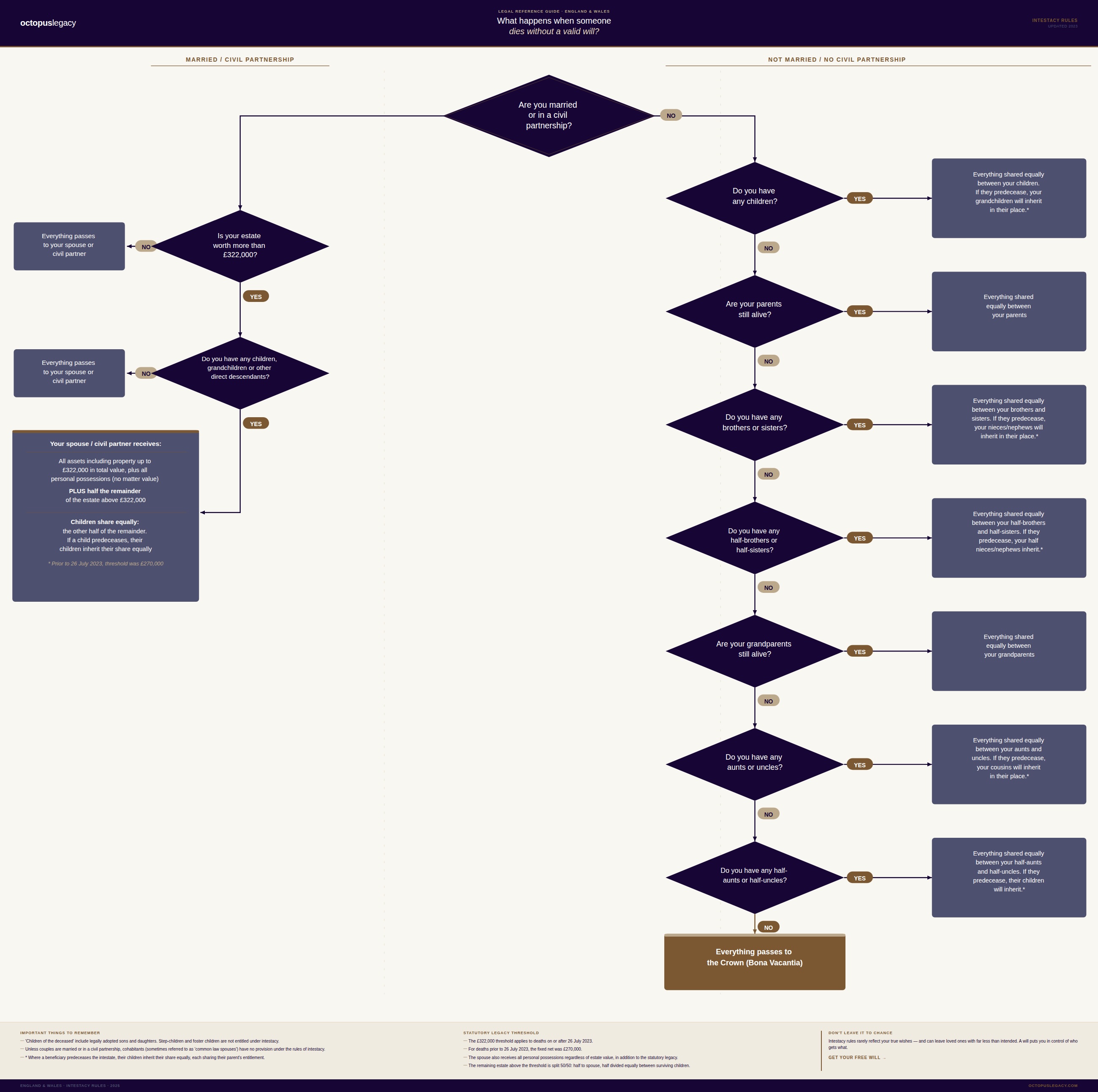
Rules of intestacy in England and Wales
In England and Wales, the intestacy rules define how someone's estate is dealt with if they die without having put their wishes into a will.
Here we go through the scenarios that apply depending on your family situation. You can also use this government tool to check for yourself if you're still unsure.
You're married or in a civil partnership with no children or grandchildren:
Your surviving partner (husband, wife or civil partner) inherits your entire estate, including money, property and possessions, as long as they survive for 28 days.
You're married or in a civil partnership and have children:
Your husband, wife or civil partner will inherit the first £322,000 (known as the "statutory legacy" amount), plus your personal possessions, whatever their value. What's remaining is then shared as follows: your spouse or civil partner gets half of what's left (if any), and the other half is divided equally between your children. If any children have died, their children (your grandchildren) inherit in their place.
The statutory legacy amount of £322,000 has applied to deaths on or after 26 July 2023. For deaths prior to this date, see here for earlier statutory legacy amounts.
You're unmarried and have children or grandchildren:
The estate is shared equally between the children, or their descendants if any of them have died.
You're unmarried and have no children:
Your estate and assets are left to close relatives in the following order:
- Parents
- Brothers and sisters. If any of them have died, then their children (your nephews or nieces) will inherit in their place.
- Half brothers and half sisters (who you share one parent with). If any of them have died, then their children (your half nephews or half nieces) will inherit in their place.
- Grandparents
- Aunts and uncles. If any of them have died, then their children (your cousins) will inherit in their place.
- Half aunts and uncles (with one parent who is your grandparent). If any of them have died, then their children (your half cousins) will inherit in their place.
If no relatives can be found in any of these categories, the entire estate passes to the Crown (known as bona vacantia).
What about cohabiting couples?
This is one of the biggest gaps in the intestacy rules, and one that catches many families off guard.
If you live with a partner but aren't married or in a civil partnership, they have no automatic right to inherit anything from your estate under the rules of intestacy. It doesn't matter if you've been together for decades, own a home together, or have children. In the eyes of the law, an unmarried partner is treated no differently from a stranger.
This applies across the entire UK: in England and Wales, Scotland and Northern Ireland.
A cohabiting partner can make a claim under the Inheritance (Provision for Family and Dependants) Act 1975 in England and Wales, but this requires a court application. There's no guarantee of success, and the process is costly, stressful and slow, often at a time when someone is already grieving.
In Scotland, a cohabiting partner can apply to the court under the Family Law (Scotland) Act 2006, but only within six months of the death. The court has discretion over what to award, and the maximum is capped at what the partner would have received had they been married.
In Northern Ireland, the position is even more restrictive. A cohabitant can only make a claim under the Inheritance (Provision for Family and Dependants) (Northern Ireland) Order 1979, and the court can only award provision for maintenance, which is typically a very modest amount.
The simplest way to protect a partner you're not married to is to write a will. A will lets you name them directly, specify exactly what you want them to receive, and avoid any court involvement. You can write your will with Octopus Legacy and make sure the person you share your life with is looked after.
Blended families and intestacy
Blended families, where one or both partners have children from previous relationships, are another area where intestacy creates problems.
Under the intestacy rules in England and Wales, only biological and legally adopted children inherit. Stepchildren have no automatic right to inherit from a step-parent's estate, even if they were raised by that person from birth.
So if you're married, have children from a previous relationship, and your new partner also has children from theirs, the intestacy rules could mean your partner's children receive nothing from your estate, and vice versa.
There's also a practical risk with the statutory legacy. If your estate is worth £322,000 or less and you're married with children, your spouse inherits everything. This can mean that children from a first marriage are left with nothing, while the surviving spouse's own children (who are not your biological children) may eventually benefit instead.
A will is the only way to make sure every child in a blended family is provided for according to your actual wishes. You can also use trusts within a will to ring-fence assets for specific people.
Rules of intestacy in Scotland
Scotland has its own succession law, and the rules differ significantly from England and Wales.
When someone dies without a will in Scotland, the estate is distributed through a system of prior rights, legal rights, and then the free estate.
Prior rights apply only to a surviving spouse or civil partner and are taken from the estate first. These include a right to the family home (up to £473,000), household contents (up to £29,000), and a cash sum (up to £50,000 if there are children, or £89,000 if there aren't).
Legal rights give the surviving spouse and any children a right to a share of the "moveable estate" (everything except land and buildings). The spouse is entitled to one-third of the moveable estate if there are children, or one-half if there are no children. Children share one-third if there's a surviving spouse, or one-half if there isn't.
The free estate is whatever remains after prior rights and legal rights have been satisfied. This is distributed to the next of kin according to a statutory order, which was simplified by the Trusts and Succession (Scotland) Act 2024.
Cohabiting partners in Scotland have no prior rights or legal rights. They must apply to court within six months for discretionary provision.
Rules of intestacy in Northern Ireland
Northern Ireland has its own intestacy framework under the Administration of Estates Act (Northern Ireland) 1955.
Married with children: The surviving spouse or civil partner receives the first £250,000 (the statutory legacy), personal possessions, and then one-third of the remaining estate. The other two-thirds are divided equally between the children.
Married without children: The surviving spouse receives the first £450,000, personal possessions, and half of any remaining estate. The other half goes to the deceased's parents, or siblings if there are no surviving parents.
Unmarried: The rules follow a similar hierarchy to England and Wales, with children inheriting first, then parents, then siblings, and so on.
As in the rest of the UK, cohabiting partners have no automatic right to inherit under intestacy in Northern Ireland. A claim can be made under the 1979 Order, but courts are only able to award maintenance provision, which is typically far less generous than in England, Wales or Scotland.
Inheritance Tax and intestacy in 2026
Dying without a will doesn't change whether Inheritance Tax (IHT) is due, but it can make the tax bill higher because you lose the ability to plan.
The key IHT thresholds for 2026 are:
Nil-rate band: £325,000. Estates below this value pay no IHT. This threshold is frozen until at least April 2030.
Residence nil-rate band: £175,000, available when a home is passed to direct descendants. Combined with the nil-rate band, this gives a potential tax-free threshold of £500,000 per person, or up to £1,000,000 for married couples and civil partners (because unused allowance transfers to the surviving spouse).
Agricultural and Business Property Relief (from 6 April 2026): 100% relief is now capped at £2.5 million per individual for qualifying agricultural (APR) and business property (BPR). Any value above £2.5 million receives 50% relief, meaning the excess is taxed at an effective rate of 20%. Married couples and civil partners can transfer unused allowance, giving a combined cap of up to £5 million.
A will allows you to structure your estate to make full use of these allowances and reliefs. Without one, you're relying on the intestacy rules, which may not distribute assets in the most tax-efficient way. For example, without a will you can't direct specific assets to specific people, create trusts, or make use of exemptions that require deliberate planning.
IHT is a UK-wide tax, so these thresholds apply in England, Wales, Scotland and Northern Ireland. However, the way assets are distributed under intestacy varies by jurisdiction, which can affect the overall tax position.
You can learn more about estate planning and how to make the most of your allowances on our estate planning page.
What are the costs of dying without a will?
One function of a will is that it can allow someone to list all of their assets in one place as an addendum to the will. Without this list it can be hard to track down everything someone owned. For example, if a family didn't know about an existing financial account, it may end up not being dealt with.
A 2014 study estimated that it can cost on average £9,700 in lost assets for families dealing with an estate when there's no will. Given the number of us who don't have a will in place, or an up-to-date one, this is far more common than it should be.
Beyond the financial cost, when there's no will it's left to family members to organise a funeral and make decisions without any input from the person who has died. When someone has funeral wishes in place it can give you peace of mind, knowing that you're respecting what they wanted.
And then there's the emotional cost. Intestacy disputes are among the most common causes of family conflict after a death. Arguments about who gets what, who's been left out, and who should be in charge can fracture relationships at the worst possible time. A will won't prevent every disagreement, but it makes your intentions clear.
How to prevent intestacy
The answer is simple: write a will.
A will lets you decide who inherits your assets, who looks after your children, and how you'd like your funeral to be handled. It also lets you appoint an executor, someone you trust to carry out your wishes.
You don't need to be wealthy or old to need a will. If you own anything, have children, or live with someone you're not married to, a will is essential.
With Octopus Legacy, you can write your will online and make sure the people you love are protected.
Frequently Asked Questions
What happens to my estate if I die without a will in the UK?
Your estate is distributed according to the rules of intestacy. These rules follow a strict order of priority: spouse or civil partner first, then children, then parents, siblings, and so on. The specific rules differ between England and Wales, Scotland, and Northern Ireland. Unmarried partners have no automatic right to inherit under intestacy law in any part of the UK.
Does my partner inherit if we're not married and I die without a will?
No. Cohabiting partners have no automatic right to inherit under the intestacy rules in England and Wales, Scotland, or Northern Ireland. This applies regardless of how long you've lived together or whether you have children. An unmarried partner may be able to make a court claim, but this is not guaranteed and can be costly. Writing a will is the simplest way to protect an unmarried partner.
What is the statutory legacy amount in 2026?
In England and Wales, the statutory legacy is £322,000 (for deaths on or after 26 July 2023). This is the amount a surviving spouse or civil partner receives before the rest of the estate is shared with children. In Northern Ireland, the statutory legacy is £250,000 where the deceased had children, or £450,000 where they did not. Scotland uses a different system based on prior rights, legal rights, and the free estate.
Do stepchildren inherit under intestacy?
No. Under the intestacy rules, only biological and legally adopted children have a right to inherit. Stepchildren have no automatic entitlement, even if they were raised by the deceased from birth. If you want stepchildren to inherit, you need to include them in a will.
Are the intestacy rules the same across the UK?
No. England and Wales share the same intestacy rules, but Scotland and Northern Ireland each have their own. Scotland uses a system of prior rights, legal rights, and the free estate, governed by its own succession law. Northern Ireland has different statutory legacy amounts (£250,000 with children, £450,000 without) and a separate legal framework under the Administration of Estates Act (Northern Ireland) 1955.
What are the Inheritance Tax thresholds in 2026?
The standard nil-rate band is £325,000 and the residence nil-rate band is £175,000, giving a potential tax-free threshold of £500,000 per person or £1,000,000 for married couples and civil partners. These are frozen until at least April 2030. From 6 April 2026, 100% relief for agricultural and business property is capped at £2.5 million per individual, with 50% relief on any excess value.
How much does it cost a family when someone dies without a will?
A 2014 study estimated that families lose an average of £9,700 in assets when dealing with an estate where there's no will. This is often due to assets going untraced because there's no central record of what the person owned. Beyond the financial cost, intestacy disputes are a common cause of family conflict after a death.
How can I make sure my wishes are followed after I die?
Write a will. A will lets you decide who inherits your assets, who looks after your children, and how your funeral should be handled. It also lets you appoint an executor to carry out your wishes. You can write your will online with Octopus Legacy to make sure the people you love are protected.